Author
James-Christian Blockwood profile headshot

By James-Christian Blockwood

View Bio

Public Administration has experienced a year of constant uncertainty and change. We talk often about these changes with respect to government operations and the impact on federal and state workers and the people they serve. But colleges, universities and the administrators and academicians within them are also impacted as part of the public administration community.

Our educators play an important role in strengthening our government institutions and communities now and in the future. It’s vital we focus on our future students and workforce, as well as the valuable research, innovation, and learning that happens at our academic institutions.

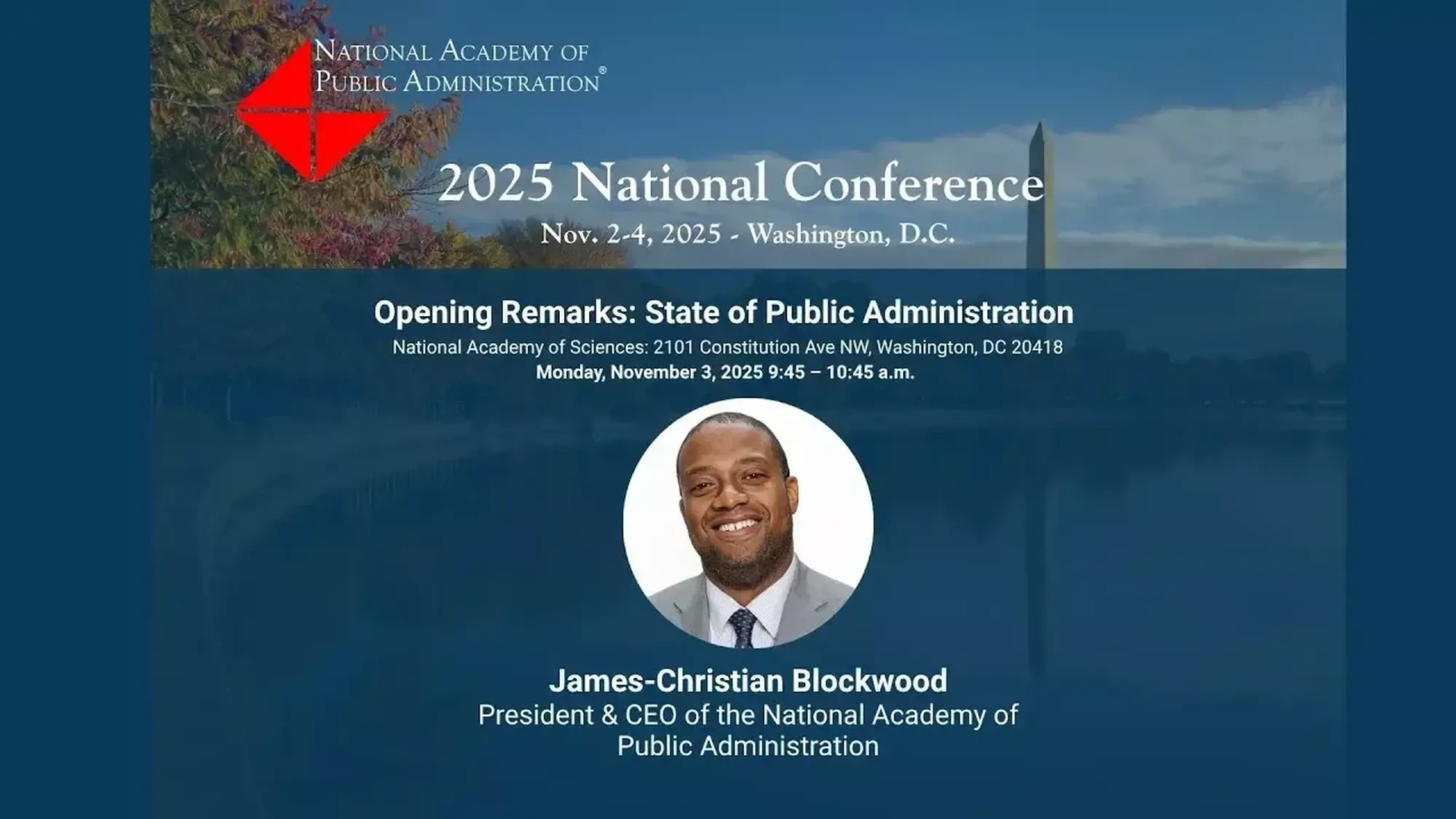
As I shared at the National Academy of Public Administration 2025 National Conference, our academic leaders are being tested and challenged, which presents an opportunity to rethink approaches but also reaffirm purpose and principles.

Earlier this year, the Academy hosted a conversation on the Future of Public Administration Education at Arizona State University’s Walter Cronkite School of Journalism and Mass Communication in Phoenix. I learned much in that brief conversation, and there were three key takeaways:

  • Amid chaos and disruption, seek to modernize and look at things in new ways.
  • Adapt to the external environment but defend important values.
  • Better articulate the power of administrative capacity and education to improve people’s lives.

The Academy can help academics in the field of public administration preserve and promote critical data and research, recruit and train next generation learners, and amplify the vital role academic institutions play in helping government solve management issues. The Academy can also help promote more public impact research, to help ensure academic insights can be applied and used by practitioners.

To strengthen American higher education and reimagine how our future leaders learn, teach and contribute to society, our government should work with academic institutions to:

  • Protect academic freedom and free speech, and ensure learning environments that foster open, honest, and healthy debate that encourages a diversity of perspectives and positions.
  • Prepare for additional technological shifts in education and incorporate new standards on the use of AI, support new curricula and teaching methods in different environments, and encouraging more specialized disciplines.
  • Invest in the public good by supporting independent data collections and interdisciplinary research, ensure adequate and reliable funding for longitudinal studies and promote open and transparent access to public information.
  • Ensure independence, but also accountability for operations within academic institutions including faculty selection, student admissions, and research priorities.

Our country's challenges are enormous, ranging from rapid advancements in technology to increased competition in a fast-evolving global landscape. America’s academic institutions contribute significantly to society and have been global leaders in the last century; they remain key to addressing these challenges, and to the success of our nation.

Back to NAPA News Article