

PODCAST: Big Changes Mean Big Challenges for Shared Services and Government HR with Academy Fellow Brodi Fontenot and OPM's Rebecca Ayers Season 2 · Ep 39
0:00
1540
PODCAST: Big Changes Mean Big Challenges for Shared Services and Government HR with Academy Fellow Brodi Fontenot and OPM's Rebecca Ayers Season 2 · Ep 39
Hear Kathy Stack, former federal leader and Senior Policy Fellow at Yale’s Tobin Center for Economic Policy, introduce the field guide project to state leaders whose approaches to integrated data informed the guide.
Sustaining high performance and evidence-based policymaking in state and local governments requires access to timely and reliable data. But financing the development, operation, and maintenance of the integrated data systems (IDS) that support these efforts requires resources that seem out of reach for program managers and data and finance leaders. An initiative of the National Academy of Public Administration (the Academy) will empower policy, data, and finance leaders at all levels of government with a shared understanding of how to leverage and combine funding for robust, efficient IDS and evaluation capacity. While the Office of Management and Budget (OMB) recently updated government-wide guidance to clarify that federal grant funding may be used to invest in IDS and evaluation, some state and local governments have already shown how to do it in practice. This initiative will pave the way for many others.
Looking for a condensed overview of the Field Guide? Click the button to download the Executive Summary.
Hear from Arkansas Chief Data Officer Robert McGough about the benefits of an integrated data system.
While some jurisdictions have found a way, robust IDS and analytic capacity are not the norm for states, localities, tribes, and territories. A key reason has been a lack of clarity and incentives around the ability to use federal funds. As a result, too many elected leaders and the public lack data-driven insights on program outcomes and how to improve them.
This field guide explains how policy, program, data, and finance leaders at all levels of government can use funding across federal grants and other sources to support robust, efficient integrated data systems and evaluation capacity. Drawing on recently updated federal guidance from the U.S. Office of Management and Budget that clarifies many areas of past confusion, this guide:
Together with further engagement across levels of government, this guide can help to develop a broader, shared vision of enterprise-wide approaches to integrated data to power evaluation and performance and to help state, local, tribal, and territorial officials access and use more sources of federal funding for better decision-making.
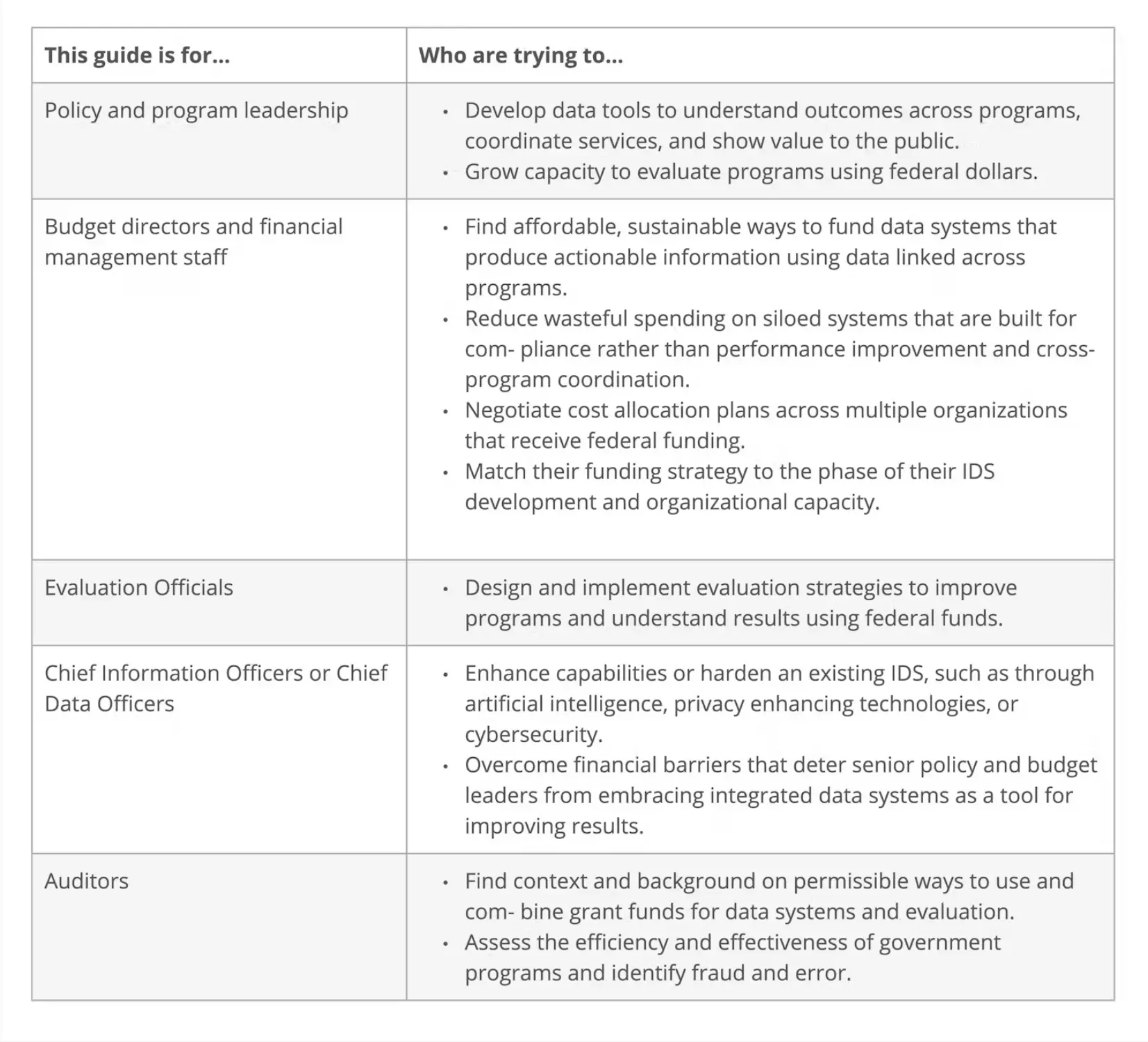
IDS can generate information that benefits stakeholders from elected leaders to auditors, from front-line program staff to the taxpaying public. This guide can help the following IDS stakeholders to address key needs:
Tennessee Chief Evaluation Officer Jonathon Attridge describes how the state’s IDS helps power its learning agenda to advance outcomes across the agencies.
The content of this guide emerged from collaboration with dozens of stakeholders inside and outside government in policy, budget, finance, data, research and evaluation, program administration, and auditing roles. The lessons learned can help all levels of government navigate existing, complex rules and processes for financing integrated data systems and evaluation capacity. These lessons also can inform future actions by the federal government that would enable and encourage many more jurisdictions to develop their capacity to use data and evaluation to get better results for taxpayers.