

PODCAST: Announcing A New Partnership for Management Matters with James-Christian Blockwood Season 2 · Ep 50
0:00
453
PODCAST: Announcing A New Partnership for Management Matters with James-Christian Blockwood Season 2 · Ep 50
Hub News
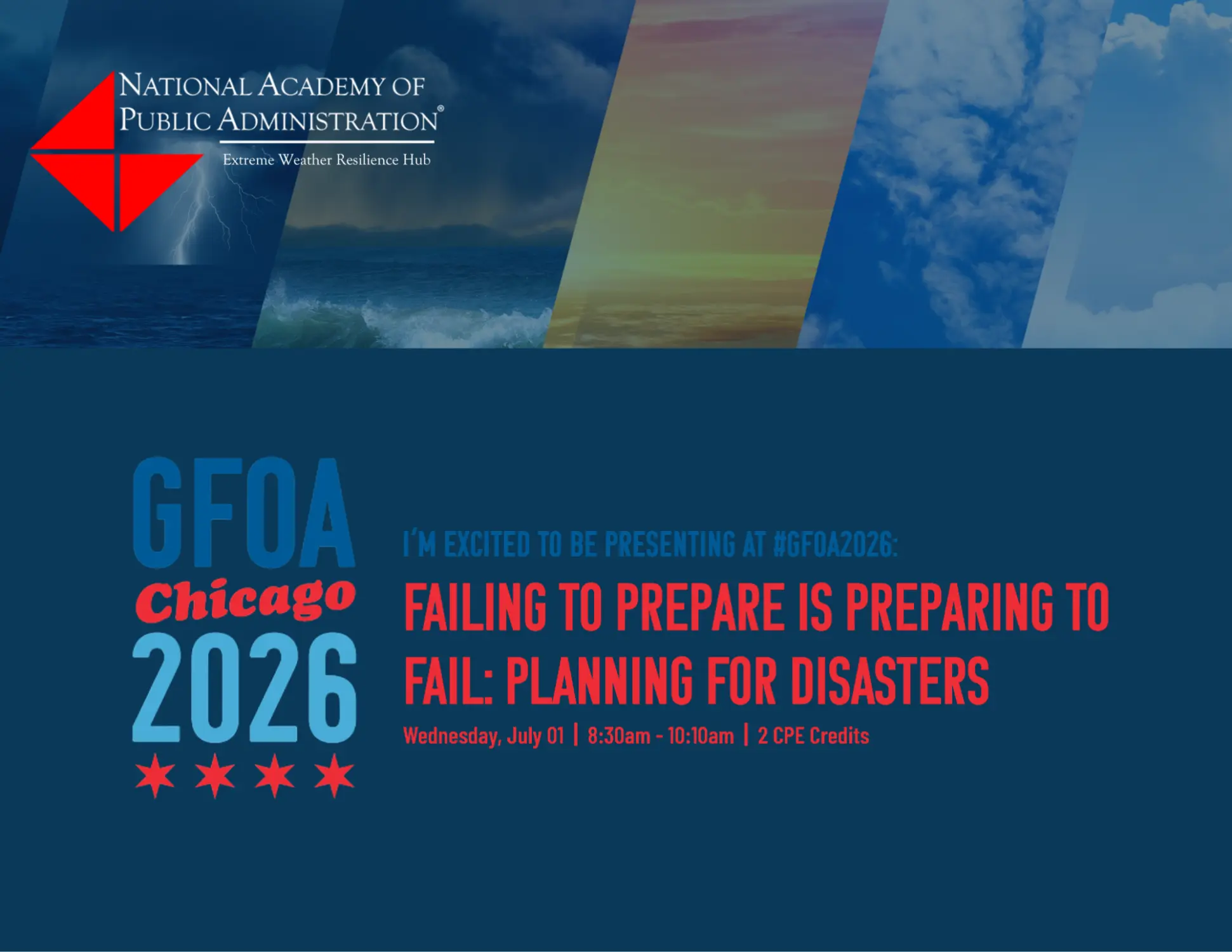
On July 1, the Lead of the Extreme Weather Resilience Hub, Amanda Mullan, attended the Government Finance Officers Association Conference to present alongside Caitlyn Wan Smith from the Pew Charitable Trust, Katie Sabo from Aon, Amanda Jones from the City of Little Rock Arkansas, and Lesley Milner from the County of Maui, on the importance of disaster planning, preparation, and resilience. The presentation, “Failing to Prepare is Preparing to Fail: Planning for Disasters” emphasized how disaster resilience encompasses challenges to governance, financing, budgeting, and strategic planning, not just emergency management. Communities that invest in preparedness, pursue financial resilience, and incorporate future risks into the decision-making process are much better positioned to withstand and recover more quickly from extreme weather events.
Throughout the presentation, there was an emphasis on a shift from a reactive emergency management approach to a proactive one. Speakers discussed how disaster recovery programs often prioritize rebuilding to restore what was in place rather than incentivizing communities to incorporate resilience into their rebuilding and recovery efforts. This status quo focus results in a cycle in which communities repeatedly rebuild or repair without addressing underlying risks through resilience. Governments should incorporate resilience well before disasters occur, using pre-disaster investments and adaptation planning to reduce future recovery costs, enhance recovery capabilities, and address risks. Communities should integrate resilience into routine capital planning and infrastructure investment decisions rather than treating it as a standalone initiative, one that is counter to other development and infrastructure goals.
Given the growing fiscal risks associated with extreme weather events, fiscal resilience and disaster planning were also highlighted during the presentation. Incorporating disaster planning and resilience into budget development allows communities to strengthen budget tools and prioritize investments that reduce the future impact of extreme weather. Inaction can impose greater costs than any adaptation or mitigation steps, which is why governments need to consider the long-term liabilities of leaving risks unaddressed. Waiting to invest may reduce short-term costs, but it can dramatically increase future recovery expenses. To ensure that fiscal resilience is incorporated into budget processes, Caitlyn Wan Smith from the Pew Charitable Trust highlighted three guiding principles:
Katie Sabo from Aon discussed what state and local governments’ ability to finance disaster recovery might resemble, especially in the face of uncertain federal assistance. Speakers encouraged local governments to think more holistically about risk and financing rather than relying on a project-by-project approach. Governments must understand their total risk exposure, including impacts on people, property, revenues, fees, and emergency operations.
The discussion also touched on the evolving Federal Emergency Management Agency policies and the increasing importance of insurance as part of a broader disaster financing strategy. Insurance was described as one tool among many, not a standalone solution, and parametric insurance was highlighted. This type of insurance provides funding based on predefined disaster triggers rather than documented property damage, which can provide supplemental recovery funds more quickly than traditional insurance mechanisms and may complement federal assistance, self-insurance programs, and conventional policies.
Governance was the other major theme of the presentation, given that those challenges often prevent communities from implementing adaptation strategies effectively. Amanda Mullan presented research identifying several persistent barriers, including fragmented authority across levels of government, reliance on historical rather than forward-looking data, disconnected funding streams, and adaptation plans that lack implementation authority. The Extreme Weather Resilience Hub (the Hub)’s approach focuses on bringing together experts to identify governance barriers, develop new institutional structures, and create scalable solutions that can be replicated in other communities. The Hub’s goal is not simply to help communities prepare for the next disaster, but to transform how governments finance, govern, and implement resilience strategies. The presentation also included real-world examples from two locations: Little Rock and Maui.
In March 2023, Little Rock experienced an EF3 tornado. The aftermath of the incident reinforced the value of preparation before disaster strikes, as the tornado completely destroyed 100 buildings and severely damaged 538 others, causing many injuries and some casualties along its path and leading to $345 million in insurance claims.12 Key recommendations that emerged from the recovery include maintaining accurate asset inventories, regularly updating photographic documentation, preserving procurement and contract records, identifying essential personnel, and ensuring financial officials are integrated into emergency response planning. This last recommendation is one that the presentation emphasized: that finance professionals need a seat at the table throughout disaster response and recovery efforts. Understanding funding sources, reimbursement requirements, and resource gaps can significantly influence a community’s ability to recover successfully and create opportunities for innovation and partnership, including new nonprofit and philanthropic collaborations that emerged during post-disaster recovery activities.
In August 2023, Maui experienced devastating wildfires, with 102 deaths, destruction of 3,000 buildings, and upwards of 12,000 residents displaced.3 Since the horrific event, emergency funding mechanisms and long-term strategies to address relocation, housing, and redevelopment challenges have helped the community to recover from the August 2023 wildfires. The presentation highlighted the importance of maintaining dedicated emergency funding mechanisms and developing long-term strategies to address challenges associated with relocation, housing, and rebuilding. Maui’s Emergency Fund, the Managed Retreat Fund, extensive community engagement efforts, the creation of an Office of Recovery, and partnerships with nonprofit organizations and community-based institutions were highlighted as approaches to tackle these issues. Maui utilized a “community-led, government-supported” recovery approach, where recovery efforts were designed around sustained community engagement with regular meetings and partnerships helping shape short-term recovery priorities and long-term resilience initiatives.
The panel's core message was clear: finance challenges need to be addressed in disaster resilience to the same extent as planning challenges. Communities cannot wait until after a disaster to act, and they cannot build resilience without the people who control the budget. Finance officers are uniquely positioned to embed resilience into everyday decisions, from capital planning to reserve funds to how risk gets priced into long-term investments. When finance officers have a seat at the table from the start, communities move from reactive recovery to proactive preparedness, reducing risk and strengthening fiscal stability for the future.
Author
Article Details
Keep Reading
We use cookies to improve your experience on our site. By continuing to use this site, you accept our use of cookies. Privacy Policy