

PODCAST: Announcing A New Partnership for Management Matters with James-Christian Blockwood Season 2 · Ep 50
0:00
453
PODCAST: Announcing A New Partnership for Management Matters with James-Christian Blockwood Season 2 · Ep 50
Hub News
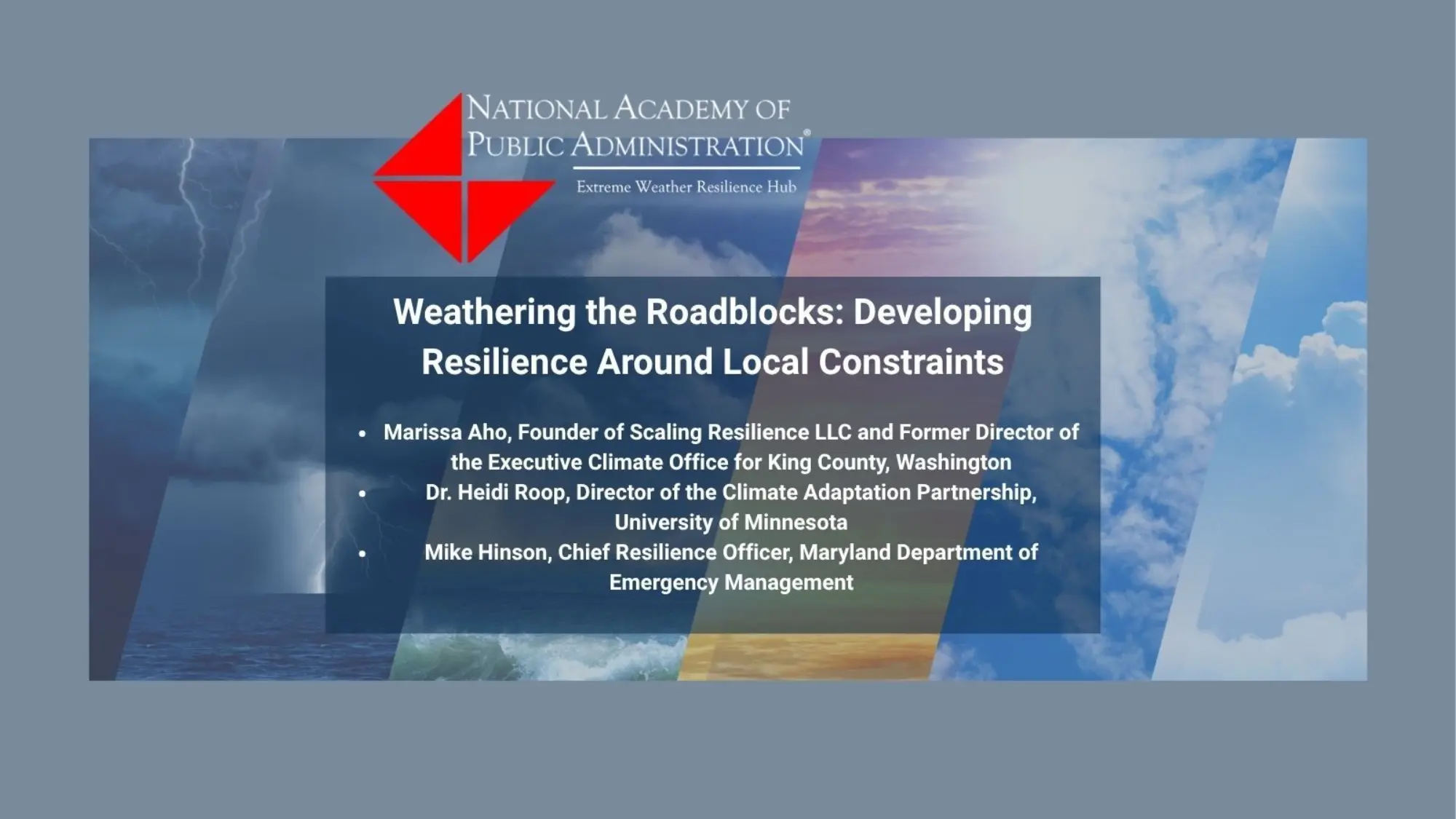
Extreme weather is occurring more frequently and severely across the nation, leaving local governments and communities at the front lines of adapting to these risks. What’s more, they’re facing significant constraints in capacity, funding, and complex coordination. On July 16th, the Extreme Weather Resilience Hub (the Hub) hosted a webinar to discuss the challenges communities face in implementing adaptation and resilience strategies at the local level and how to manage roadblocks. The discussion featured:
The panelists explored the barriers that prevent communities from advancing resilience initiatives, beyond funding and politics, and identified practical approaches to help all communities move forward with implementation.
Communities may already be building resilience—even if they do not call it that.
Communities do not always need to start resilience planning from scratch. As the panelists discussed, many local governments are already making investments that strengthen resilience, even if those efforts are not labeled that way. Marissa Aho emphasized that communities can begin by imagining the worst possible headline they want to avoid, then identifying the actions needed to prevent that outcome. This approach can help create urgency, clarify priorities, and bring the right stakeholders to the table before disaster strikes. Dr. Heidi Roop added that resilience often emerges from practical community needs rather than standalone climate planning. Infrastructure improvements, public safety upgrades, and watershed projects may be pursued because they solve immediate problems, while also reducing long-term risk. Building on this point, Mike Hinson stressed the importance of understanding what work is already underway before deciding what comes next. Because resilience projects can be large and costly, local leaders need a clear baseline to identify gaps, track progress, and determine where future investments can have the greatest impact.
Planning is important, but it’s only the beginning. Turning resilience plans into action requires sustained funding and a strong business case.
Completing a resilience plan is only the beginning. As the panelists noted, many communities struggle to move from planning to implementation, especially once the momentum of finishing a plan fades. Marissa Aho pointed to this gap as a common barrier: communities may celebrate the completion of a plan but then struggle to launch the projects it identifies. Bureaucratic processes, including lengthy administrative procedures and procurement rules, can further slow progress. Mike Hinson emphasized that overcoming these barriers requires long-term revenue strategies that do not depend solely on one-time federal grants. Without recurring funding, communities may complete a single project but lack the resources to sustain broader adaptation and resilience efforts over time.
The panelists also emphasized the importance of making a clear business case for resilience. Heidi Roop noted that national statistics about the benefits of adaptation can be helpful, but local leaders often need project-specific evidence that shows the expected return on investment. Hinson added that demonstrating bottom-line impacts—and working with partners such as the insurance industry to show risk reduction benefits—can help make resilience investments more compelling. Roop also underscored the need to demystify resilience, reminding participants that it is not limited to major infrastructure projects. Practical investments such as road improvements, early warning systems, and other public services can also strengthen a community’s ability to withstand extreme weather.
Resilience work is more effective when communities build on existing regional plans, coordinate across boundaries, and embed resilience into everyday planning decisions.
Extreme weather does not stop at jurisdictional boundaries, so resilience planning cannot happen in isolation. The panelists emphasized the importance of coordinating across local governments, agencies, and regional partners to share knowledge, align investments, and move projects forward more effectively. Mike Hinson described Maryland’s efforts to build communities of practice that connect organizations working on resilience-related challenges. These networks can help communities identify funding opportunities, learn from one another, and coordinate activities across jurisdictions. Heidi Roop added that resilience should be embedded into existing planning processes, not treated as a standalone effort. Integrating resilience into transportation plans, economic development strategies, and capital investment decisions can make it part of routine decision making while creating more opportunities for regional cooperation. Marissa Aho reinforced this point, noting that communities do not always need to create new plans when useful regional frameworks already exist. By adopting and adapting proven strategies, local governments can save time, avoid duplication, and accelerate implementation.
Adaptation and resilience planning and implementation are not always linear, and fostering community trust is as important as technical planning.
Resilience planning does not always follow a straight path. As Marissa Aho noted, meaningful progress often happens when funding opportunities, political support, and partnerships align at the right moment. While long-term planning remains important, communities also need the flexibility to act when those conditions come together. Mike Hinson emphasized that successful resilience investments depend on community buy-in. Even technically sound solutions can fall short if residents do not understand the purpose of a project or feel excluded from the decision-making process. Heidi Roop brought the conversation back to the human side of resilience, reminding participants that these decisions affect people’s homes, livelihoods, identities, and connections to place. For that reason, conversations about adaptation, relocation, or retreat must be grounded in trust, empathy, and sustained public engagement.
The panelists also emphasized that engagement must begin early and continue throughout the planning process. Successful resilience efforts require more than informing residents about decisions that have already been made; they require creating meaningful opportunities for community members to shape outcomes. Residents bring important knowledge about local hazards, vulnerabilities, and priorities that technical analyses alone may miss. Trust is built when people feel heard and when engagement is treated as genuine dialogue rather than one-way communication.
The discussion made clear that awareness is no longer the biggest barrier to resilience; implementation is. Communities understand the growing risks posed by extreme weather, but many still face challenges when turning plans into sustained action. Panelists emphasized that resilience depends on more than technical expertise. It requires governance structures with the authority and financing capacity to move beyond ad hoc coordination, paired with a clear economic case for investment and meaningful public engagement. Above all, resilience must be grounded in community experience and trust. The strongest efforts are those that protect people, strengthen relationships between residents and government, and ensure communities have an active role in shaping their own future.
Author
Article Details
Keep Reading
We use cookies to improve your experience on our site. By continuing to use this site, you accept our use of cookies. Privacy Policy