

PODCAST: Announcing A New Partnership for Management Matters with James-Christian Blockwood Season 2 · Ep 50
0:00
453
PODCAST: Announcing A New Partnership for Management Matters with James-Christian Blockwood Season 2 · Ep 50
Hub News
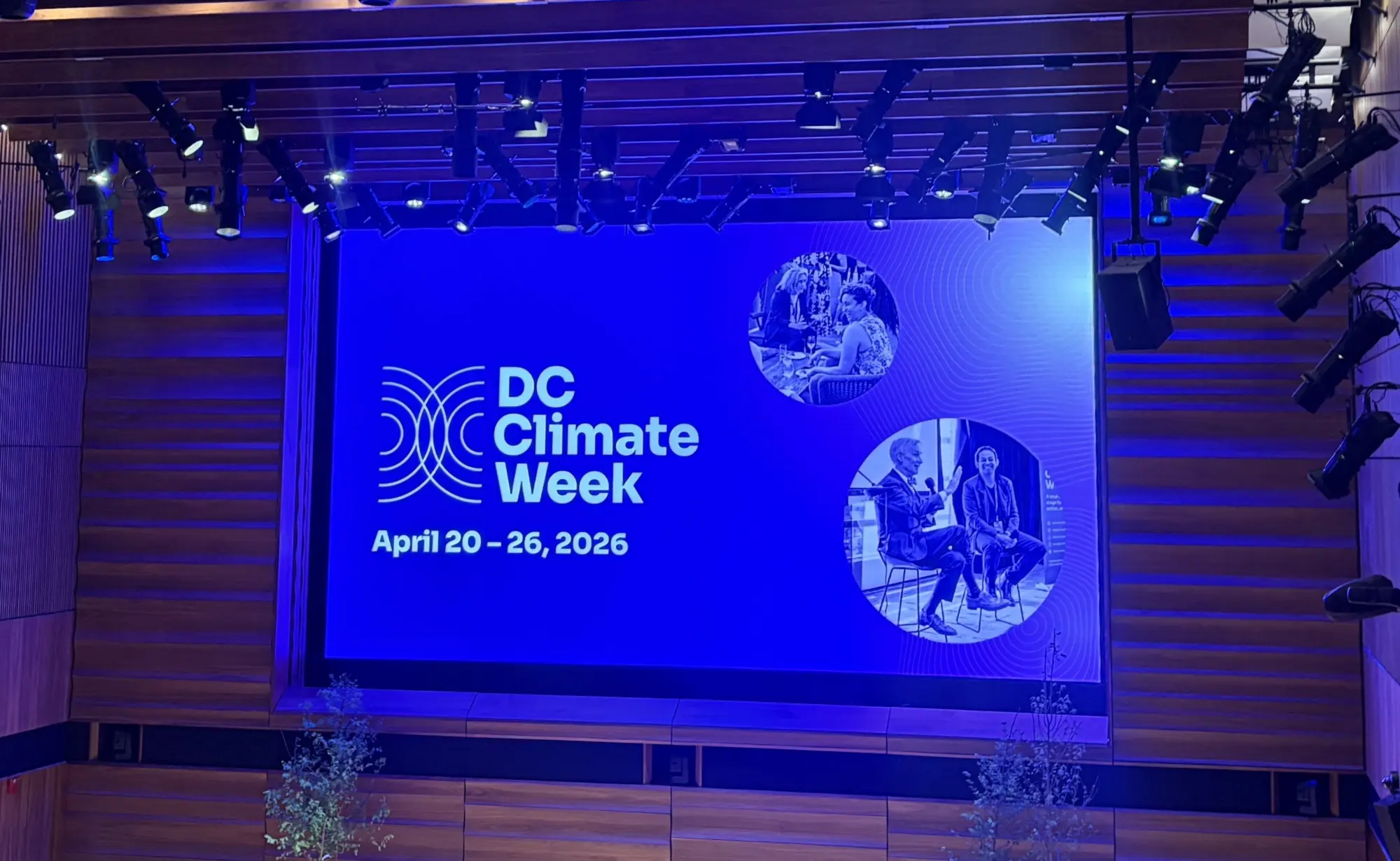
From April 20 to 26, 2026, DC hosted Climate Week, a community-organized week of events, gatherings, and exhibitions that focused on solutions needed to address extreme weather and other challenges. The Extreme Weather Resilience Hub’s staff attended multiple events throughout the week, engaging with practitioners and experts from across the country and collecting insights on how to address governance and policy challenges in climate resilience.
The week featured far more events that staff members could attend, but the following four highlight exciting, insightful, and relevant work aligned with the Hub’s focus on how governance must intertwine with adaptation and resilience in dealing with extreme weather.
As communities face increasingly complex climate and infrastructure challenges, practitioners are calling for a shift in how resilience is defined, planned, and implemented. Duke University hosted the event to discuss the recently published guide, produced in collaboration with AECOM, Bentley, American Society of Civil Engineers, and Microsoft. It highlights a central tension in current practice: while many resilience efforts are well-intentioned, they are often pursued at the individual level, resulting in investments that, while they may help one community, are counterproductive to system-wide resilience.
To support a transition away from these overly individualized efforts, the guide identifies three foundational pillars:
Addressing resilience is not only technically challenging; it also requires sufficient capacity in all senses of the word. Effective implementation necessitates training and workforce development, access to resources and funding, and improved communication. The guide also notes the need to better distinguish between “fundable” and “financeable” projects. While many resilience initiatives may qualify for grant funding, fewer are structured to attract private investment or long-term financing.
The integrated resilience approach outlined in the guide represents a significant shift from traditional resilience infrastructure planning. It calls for moving beyond fragmented, asset-level interventions toward coordinated, system-wide strategies supported by aligned policies, advanced tools, and empowered decisionmakers. Resilience is not just about protecting what exists, but about fundamentally rethinking how systems are designed, governed, and sustained in an increasingly uncertain world. To learn more about adaptation and resilience, check out the Hub’s blog post.
As communities plan for adaptation, a common challenge relates to how to coordinate resilience investment and how to blend public and private sector capital. Duke University hosted a roundtable discussion that addressed efforts to shift from project-by-project efforts to address extreme weather incidents, toward a coordinated approach to resilience financing and planning. A consistent theme throughout the discussion was that individual adaptation projects are too small, fragmented, and complex to attract private capital. Unlike areas such as housing or clean energy, which have existing aggregation models and standardized financing pathways, resilience projects often lack a clear unified structure. Private investors often seek opportunities on a larger scale, far beyond one-off infrastructure upgrades to increase one community’s resilience.
A potential solution to this challenge can come from organizations that serve as intermediaries and aggregators. Institutions like the Milken Institute’s Community Infrastructure Center are experimenting with mechanisms such as “deal rooms” that match developers with potential projects. Similarly, global actors like the World Bank emphasize a portfolio-based approach, noting that investors are far more likely to engage when projects are bundled into larger, diversified investments.
Advancing resilience financing will require a layered, interconnected system of tools and institutions that can bridge gaps across sectors, scales, and timelines. Ultimately, improving alignment between adaptation projects and the investment community will depend not just on new funding sources, but on rethinking how projects are structured, aggregated, and communicated across stakeholders. To read more about emerging governance structures that can be leveraged to advance resilience financing, read the Hub’s blogs on Resilience Districts and Resilience Authorities.
As the role of the federal government continues to evolve, local governments are exploring and expanding new partnerships to address climate resilience in their communities. In this panel and roundtable discussion hosted by AECOM, panelists discussed cross-sector collaboration, planning, and design for climate-resilient communities across the Capital area. The activity drew perspectives from public, private, and nonprofit stakeholders, providing a discussion that underscored the importance of aligning policy, funding, and cross-sector collaboration to accelerate progress.
Panelists emphasized policy as a key driver of resilience outcomes, pointed to persistent funding challenges, and underscored the need for stronger cross-agency collaboration. The conversation also highlighted the importance of data-driven decision making and tackling complex trade-offs, such as balancing development with environmental risk. Speakers shared examples from across the region that show these ideas in action, from local climate action planning to investments in grid modernization and nature-based solutions. There was also growing focus on aligning mitigation and adaptation goals, alongside recognition of how difficult it can be to define and measure success in resilience. The discussion closed with a call for greater regional coordination and public engagement, noting that long-term resilience depends on sustained collaboration across jurisdictions, sectors, and communities.
The Climate and Environmental Data Day, cohosted by the Data Foundation, the Impact Project, the Environmental Policy Innovation Center, and others, underscored a core challenge in climate work: while data is abundant, it remains fragmented, difficult to access, and not always aligned with decision making needs. Climate data systems function as an interconnected ecosystem that depends on sustained federal investment, shared data infrastructure, and the people who manage and interpret data systems.
A key theme discussed at the event was the disconnect between data and policy action. Decision makers often operate on fast timelines that do not match the pace of analysis, limiting effective data use. Gaps in context, limited data, and high staff turnover further complicate efforts to integrate evidence into policy making. Additionally, there are challenges in governance and trust. Inconsistent standards, limited data sharing, and disruptions to federal data access have weakened confidence in data systems, making it hard to make decisions and maintain public trust. Participants stressed the need for transparency, interoperability, and stronger governance frameworks to improve data-based decision making and trust. These steps are especially important as many communities consider incorporating new AI tools.
At the same time, state and local actors are advancing more applied uses of data. Current efforts undergoing in Maryland related to climate decision making and demand for hyper-local data demonstrate how subnational governments are filling gaps, though they still rely on federal systems for scale and consistency. The conversations at the Climate and Environment Data Day event made clear that the challenge is no longer just collecting climate data; rather, it is building the governance, trust, and connectivity necessary to turn that data into meaningful, timely action.
Taken together, these conversations point to a broader lesson: resilience is not built through isolated projects, but through stronger systems of governance, financing, and data use. As extreme weather grows more frequent and complex, the most effective responses will come from institutions that can connect expertise to action and turn shared insight into long-term change.
Authors
Article Details
Keep Reading
We use cookies to improve your experience on our site. By continuing to use this site, you accept our use of cookies. Privacy Policy