

PODCAST: From the Federal Level to the MTA, the Data Revolution Has Changed How Government Operates Forever Season 3 · Ep 4
0:00
2361
Standing Panel News
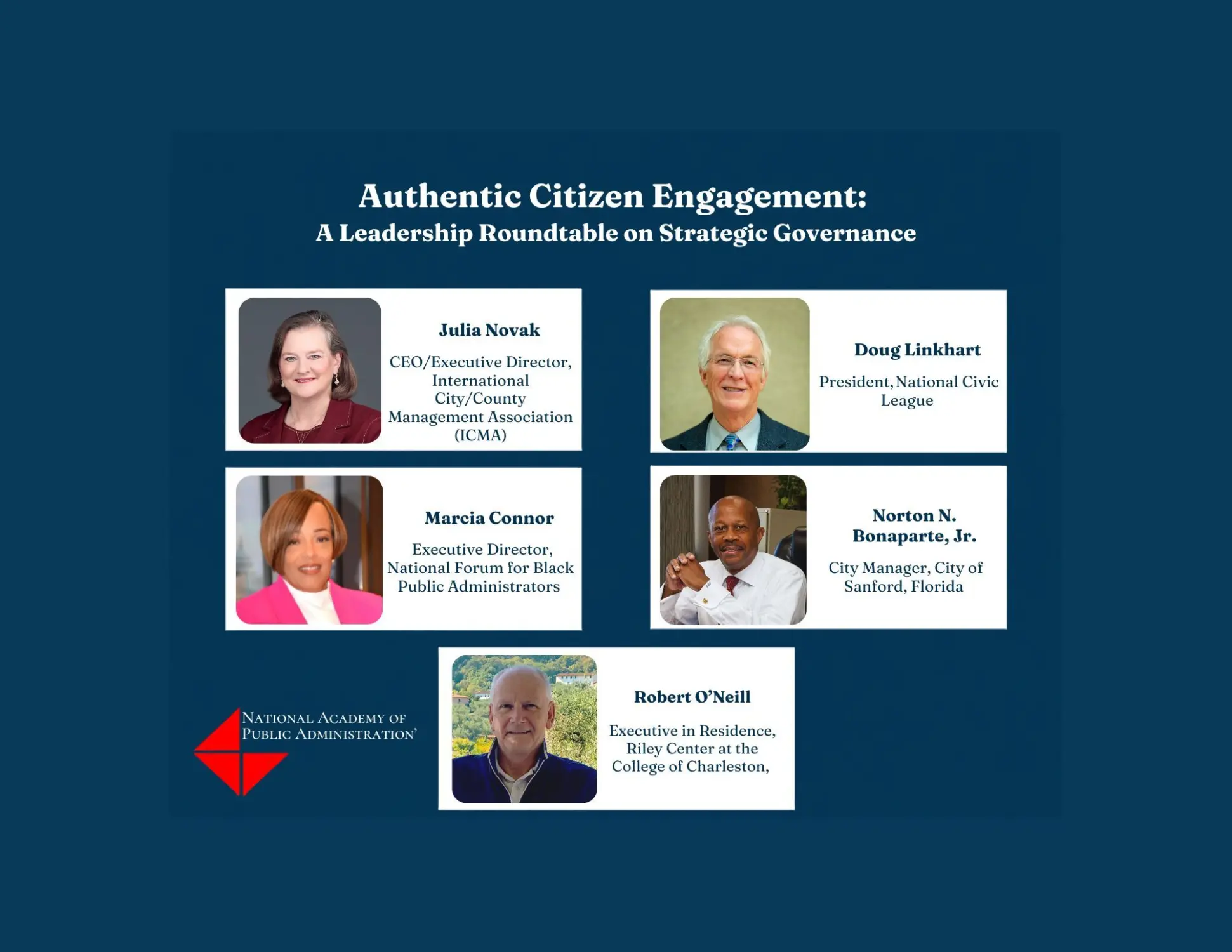
Local governments routinely invite residents to public hearings, distribute surveys, and request comments on proposed policies. These activities can be important tools, but authentic citizen engagement requires more than a public hearing or survey. During a National Academy of Public Administration webinar on August 31, 2026, local government practitioners and civic engagement experts underscored that authentic engagement requires more than procedural compliance. Their message was simple: engagement is most effective when governments are clear about their purpose, reach beyond the usual participants, listen seriously to disagreement, and demonstrate how public input influenced decisions.
Begin with a clear purpose
Julia Novak (Academy Fellow and CEO/executive director of ICMA, the International City/County Management Association) distinguished authentic engagement from simply “checking the box.” Before inviting the public into a process, local leaders should be able to explain why they are seeking participation, what level of influence residents will have, and how their contributions may affect the outcome. Without that clarity, residents may enter a process expecting to help shape a decision only to discover that officials were merely providing information or validating a course already chosen.
Not every decision requires the same form of participation. Governments may need to inform residents in one situation, consult them in another, or collaborate with them to design and implement a solution. In some cases, such as participatory budgeting, residents may exercise direct authority over defined resources. The important point is to select an approach suited to the decision and to be transparent from the beginning about where final decision-making authority rests.
Look Beyond the Loudest Voices
Public processes often rely on highly engaged participants, creating an opportunity for local governments to seek out additional perspectives and experiences from across the community.Norton Bonaparte (Academy Fellow and City Manager of Sanford, Florida) shared a useful reminder from an ICMA conference: “volume is not consensus.” He also cautioned that the people represented in the available data are only part of the picture, as many residents never participate in surveys or formal meetings.
Novak added that the quietest voice can sometimes be the one decision makers most need to hear. A majority count can obscure residents who are less comfortable speaking publicly, have less time to participate, or are directly affected by a decision but are not well organized. The practitioner’s role includes helping elected leaders understand who has been heard, who has notbeen heard, and which communities are most relevant to the decision.
Building broader participation often begins with meeting residents where they already are.Perhaps the webinar’s most consistent practical advice was to stop expecting engagement to occur primarily at city hall. Bonaparte described meeting residents through community organizations, festivals, neighborhood gatherings, soccer games, Rotary meetings, and chamber events. His closing recommendation was simple: “get out of city hall and go where people live their daily lives.”
Heather Fatzinger (President and CEO, Full Circle Communications) made a similar point, noting that governments may need to engage residents at transit stations, daycare facilities, grocery stores, and other places frequented by people whose schedules make conventional meetings difficult. The right location and communication method will vary across communities. Making the effort to understand those differences signals that the government values residents’ time and circumstances.
Fatzinger also stressed that engagement strategies must be tailored to the community. Residents are more likely to participate when information is accessible, meetings feel welcoming, and outreach occurs through trusted local leaders.
Finding Value in Different Perspectives
Authentic engagement helps communities surface different perspectives, concerns, and ideas that can lead to better decisions. Novak argued that disagreement can reveal unanticipated consequences and sometimes point toward novel solutions. Bonaparte similarly noted that conflict demonstrates that people care about the outcome and can expand the range of options under consideration. Doug Linkhart (President of the National Civil League) added that local governments should not focus on avoiding conflict but on ensuring that people feel heard and that disagreements are handled with civility and respect.
Build the capacity to listen and respond
Bob O'Neill (Executive in Residence, College of Charleston) argued that local governments need stronger “active listening” capabilities and greater investment in civic infrastructure, the networks, relationships, and institutions that help communities identify shared priorities and work toward the common good.
Effective engagement creates an ongoing dialogue between governments and residents. Fatzinger urged governments to return to communities and explain what they heard, what they did with the information, and how that input shaped decisions and future actions. That feedback loop demonstrates that resident participation matters and strengthens trust over time. Trust grows through repeated, honest communication rather than a single successful meeting.
The webinar participants repeatedly returned to a common theme: authentic engagement begins when governments stop asking, “How do we get people to come to our meeting?” and start asking, “How do we meet people where they are?” Together, clear purpose, inclusive outreach, productive dialogue, and visible follow-through form the foundation of stronger communities and stronger local democracy.
Wendy D. Chen, Ph.D. (Associate Professor of Public Administration, Texas Tech University, and author of Innovation and Entrepreneurship in the Public Sector (Oxford University Press), organized and moderated the panel discussion. A recording of the event is available here.
Article Details
Standing Panel
Keep Reading
We use cookies to improve your experience on our site. By continuing to use this site, you accept our use of cookies. Privacy Policy